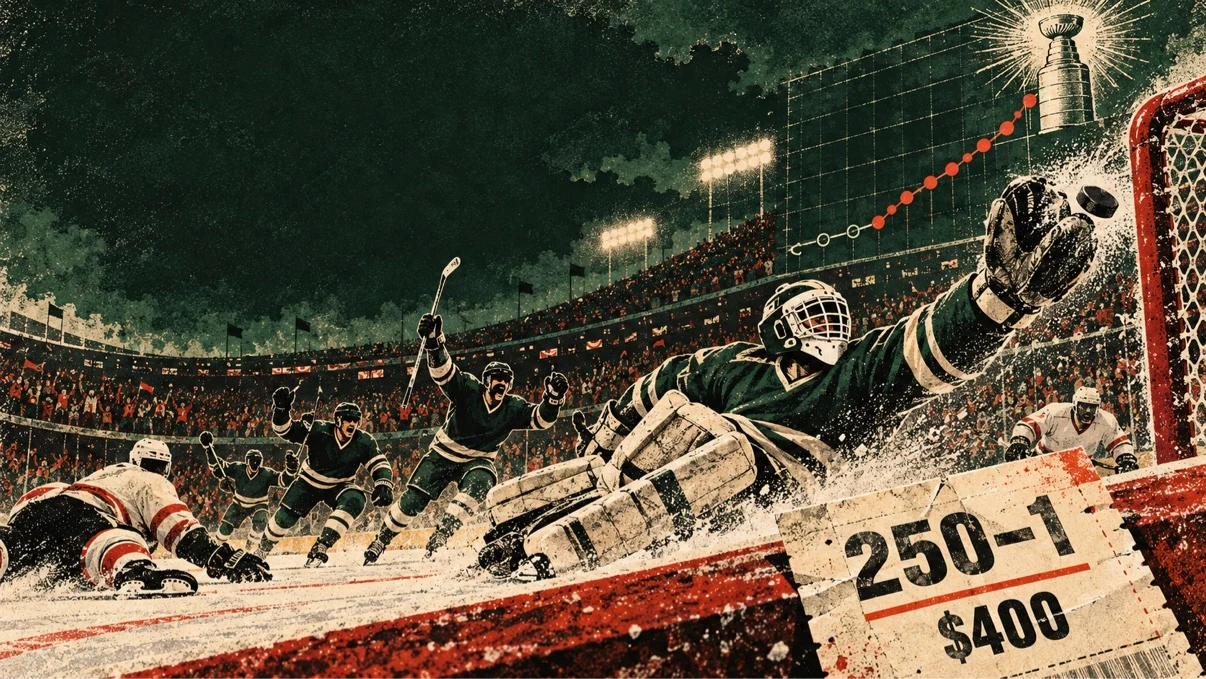
The ticket
In January 2019, Scott Berry had a little time left before his flight home from Las Vegas.
Berry was a St. Louis Blues fan. He was also a casual gambler who had planned to spend a few hundred dollars playing table games during his trip. That never happened, so he stopped at a sportsbook instead.
He looked up at the futures board and found the Blues listed at 250-to-1 to win the Stanley Cup.
They were at the bottom of the NHL standings.
He bet $400 anyway.
If the Blues won the Cup, the ticket would produce a $100,000 profit. With his original stake returned, Berry would collect $100,400.
At the time, it looked like an extremely expensive souvenir.
Five months later, it became one of the most famous winning hockey tickets ever printed.
The NHL's last-place team
There was no obvious reason to believe in the Blues.
On New Year's Day, they had a 15-18-4 record and only 34 points. They were tied near the bottom of the league and outside the playoff picture.
The team had already fired head coach Mike Yeo on November 19. Craig Berube was running the bench as interim coach. The Blues had entered the NHL in 1967 and had never won the Stanley Cup.
Their odds reflected all of that.
Berry found the Blues at 250-to-1 at the Paris Las Vegas sportsbook. Another sportsbook reportedly offered only 150-to-1, so he returned to the better price and placed his wager.
That difference mattered.
A $400 bet at 150-to-1 would make a $60,000 profit. At 250-to-1, the same bet made a $100,000 profit.
Shopping for the better number added $40,000 to the possible payout without increasing the size of the bet.
What 250-to-1 actually means
Fractional odds of 250-to-1 are the same as American odds of +25000.
For every $1 wagered, the ticket makes a $250 profit if it wins.
Here is what that looks like with actual stakes:
- A $10 bet makes a $2,500 profit and returns $2,510.
- A $100 bet makes a $25,000 profit and returns $25,100.
- Berry's $400 bet made a $100,000 profit and returned $100,400.
The implied probability is approximately 0.4%.
In plain language, the price represented roughly one chance in 251.
That does not mean the sportsbook knew the Blues would win once every 251 seasons. Betting odds are prices, not perfect predictions. They are influenced by the sportsbook's estimate, the money being wagered and the margin built into the market.
But the message behind the number was clear: the sportsbook considered a Blues championship extremely unlikely.
The rookie who changed the season
Jordan Binnington was 25 years old and had spent most of his professional career in the minor leagues.
On January 7, he made his first NHL start and stopped every shot in a shutout victory.
He finished the regular season with a 24-5-1 record, a 1.89 goals-against average and a .927 save percentage. With Binnington in net, the Blues suddenly stopped looking like the worst team in hockey.
Beginning in late January, they won 11 consecutive games.
St. Louis finished the regular season 30-10-5 over its final 45 games and climbed into third place in the Central Division.
The 250-to-1 ticket was no longer a joke. It was now valuable enough that Berry had a decision to make.
Sell it, hedge it or let it ride
As the Blues advanced, Berry could have tried to lock in a profit.
He could have sold the ticket through a resale service. He also could have wagered on the Blues' opponents, creating a hedge that would pay him something regardless of which team won.
Berry turned down those options.
He told ESPN that he had placed the bet because he believed in his team. He wanted to stay with the original wager rather than trade the possibility of $100,000 for a smaller guaranteed return.
That choice made the final round much more than a hockey series for one Blues fan.
Every goal changed the value of a small piece of paper he had purchased months earlier.
The road to Game 7
The Blues defeated the Winnipeg Jets in six games, the Dallas Stars in seven and the San Jose Sharks in six.
That sent St. Louis to its first Stanley Cup Final since 1970.
Boston entered the Final as the favourite, with sportsbooks opening the Bruins at approximately -150 to win the series.
The teams split the first six games.
Game 7 was played on June 12 at TD Garden in Boston. The Bruins controlled much of the opening period and forced Binnington to make several difficult saves.
St. Louis escaped the period with a 2-0 lead.
Ryan O'Reilly redirected the first goal past Tuukka Rask. Alex Pietrangelo added another with fewer than eight seconds remaining in the period.
Boston finished the game with 33 shots. Binnington stopped 32 of them.
Brayden Schenn and Zach Sanford added third-period goals, and the Blues won 4-1.
For the first time in franchise history, St. Louis had won the Stanley Cup.
O'Reilly received the Conn Smythe Trophy as the most valuable player of the playoffs. The Blues became the first NHL team to win the championship after sitting last in the league more than 30 games into a season.
And Berry's ticket cashed.
The final numbers
Original wager: $400
Odds: 250-to-1, or +25000
Profit: $100,000
Original stake returned: $400
Total payout: $100,400
Approximate implied probability: 0.4%
A $100 ticket at the same odds would have made a $25,000 profit and returned $25,100.
For comparison, St. Louis had been available at approximately +3000 before the season. A $100 bet at that price would have made a $3,000 profit and returned $3,100.
Waiting until the Blues had fallen to the bottom of the standings created a much bigger potential payout. It also meant betting on a team that appeared far less likely to win.
What this ticket does — and does not — prove
It is tempting to look at Berry's ticket and see a strategy.
Find a struggling team. Bet at enormous odds. Wait for a miracle.
That is not what the story proves.
Thousands of longshot futures tickets lose across professional sports every year. A 0.4% implied probability is still only 0.4%. Most teams priced at 250-to-1 do not suddenly discover an elite rookie goaltender, win 11 games in a row and transform themselves into champions.
The Blues did.
A rookie goaltender became one of the league's best players for half a season. An interim coach found the right lineup and system. A last-place team won 30 of its final 45 regular-season games and then survived four playoff rounds.
That was not a repeatable betting system.
It was an extraordinary hockey story attached to an extraordinary ticket.
That is why it belongs in The Underdog Files.
Many regulated sportsbooks offer championship futures, although available markets and prices differ between operators. If you choose to wager, compare the odds and market rules before placing a bet. Futures can remain unsettled for months, and extremely large potential payouts reflect an extremely small chance of winning.
Nothing in this article is a betting recommendation.
Sources and method
Odds and payout figures checked against contemporary sportsbook reporting and the cited sources. Facts checked 9 October 2026.
Darren Rovell on Berry's 250-to-1 ticket, Action Network ↗
ESPN on the $400-to-$100,000 payout, via Golf Digest ↗
January 2019 odds board and Final prices, sportsbetting.legal ↗
Blues win first Stanley Cup, bettor wins $100K, sportsbetting.legal ↗